
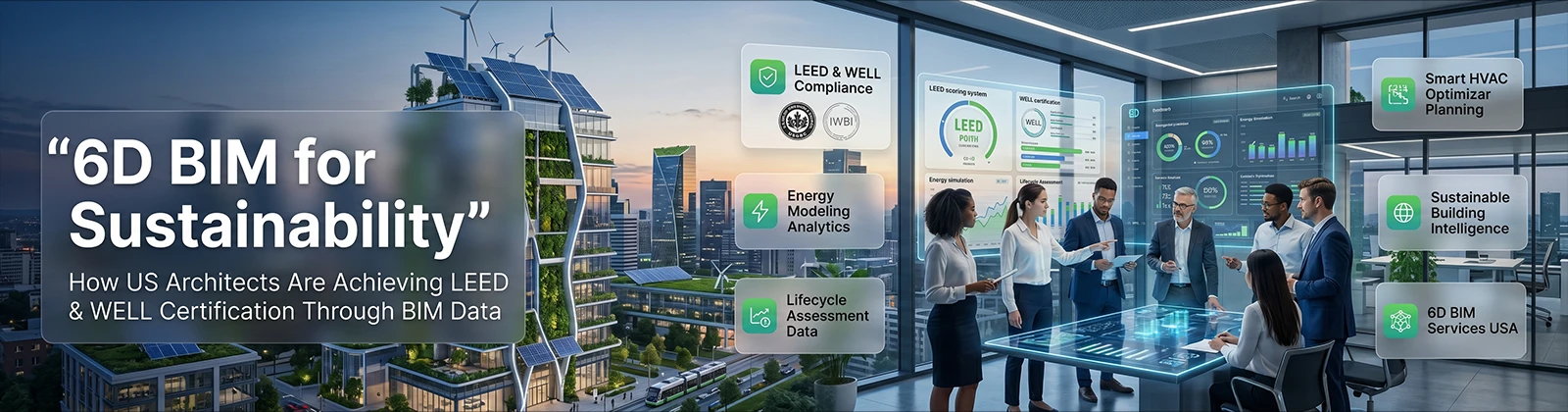
With organisations moving toward obtaining LEED (Leadership in Energy and Environmental Design) and WELL certifications, which is a globally recognized, evidence-based building standard managed by the International WELL Building Institute (IWBI), sustainable architecture is evolving quickly in the USA. Through 6D BIM, architects can use better sustainability data to seamlessly integrate data from the initial design process, optimizing the performance of a building and reducing the cost of operation. By using Designheed US's advanced BIM solutions, architects can efficiently execute their green building strategies and reach their long-term sustainability goals.
What is 6D BIM?
The 6D of Building Information Modeling (BIM) or 6D BIM integrates sustainability in USA and facilities management information into the existing building model.
Traditional BIM processes start with:
- 3D BIM for building visualization,
- 4D BIM for scheduling,
- 5D BIM for estimating cost.
Thus, incorporating sustainability analysis of the building is what defines 6D BIM and expands upon the capabilities of 3D, 4D, and 5D by adding operational performance, energy use, life-cycle management, and environmental impact.
In simpler terms, 6D BIM for green building provides engineers and architects with a way to evaluate a building's performance before the actual building construction for areas such as energy efficiency, lighting levels, HVAC (heating/ventilation/air conditioning) systems, water usage, and carbon emissions without physically building anything in real life.
The 6D BIM process enables project teams to build environmentally friendly buildings while also decreasing expensive redesigns later in the project.
6D BIM services in the United States also assist in maintaining facilities with long-term storage of maintenance schedules, equipment specifications, and other asset management information visible directly within the BIM structure.
How 6D BIM Supports LEED & WELL Certification
One of the biggest advantages of BIM for LEED compliance in the USA is the easier sustainability analysis and certification process through 6D BIM.
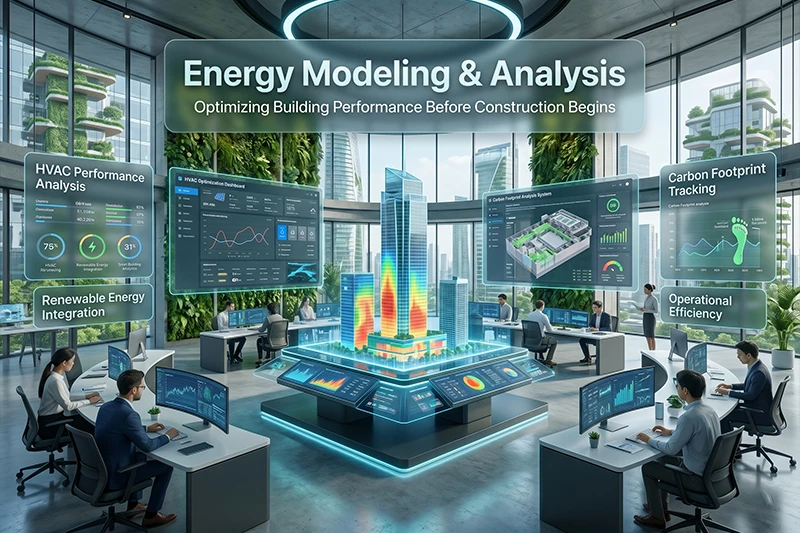
- Energy Use Performance Measurement - 6D-BIM can be used by architects to simulate energy use throughout the entire design phase of buildings, allowing teams to evaluate insulation systems, building orientation, HVAC efficiency, glazing performance, and integration of renewable energy sources before construction.
As an example, a commercial office building located in the state of Texas can utilize BIM analysis to optimally reduce its annual energy usage while maximizing the potential of earning the most LEED energy credits available for that building.
- Daylight Simulation - The amount of daylight finding its way into a building plays an important role for both the LEED certification and the WELL certification standards. Architects can improve the comfort of building occupants while minimizing or eliminating their use of electricity to power artificial light by following established workflows that employ Building Information Modeling (or BIM) to evaluate different influences on natural daylighting, glare, and electric lighting performance.
- Water Conservation Planning - Water conservation is an important component of sustainability. 6D-BIM models can assess the plumbing configurations, rainwater collection systems, and performance of low-flow fixtures to maximize water efficiency throughout the entire useful life of the building.
- Decreased Carbon Footprint - The selection of materials that are being incorporated into a project is one of the most significant factors affecting the overall environmental impact of that project. The BIM sustainability data utilized by architects while working within the 6D-BIM modelling environment will allow the design team to compare materials against four categories of embodied carbon, lifecycle impact, durability, and recyclability.
- Tracking Indoor Environmental Quality - WELL certification is primarily concerned with the health and well-being of a building's occupants. 6D BIM provides a means to track aspects of indoor environmental quality, such as indoor air quality, thermal comfort, ventilation systems, and acoustical performance, to ensure a healthier indoor environment.
- Material Lifecycle Analysis - Architects can take advantage of 6D BIM's ability to assess the long-term performance of building materials. This includes evaluating maintenance schedules, expected replacement dates, lifecycle costs, and the overall sustainability impact of materials.
- Sustainable Asset Management - 6D BIM continues to add value to an asset after project completion by providing centralized data about facility management for building owners. Owners are able to track maintenance activities along with energy performance and operational efficiency in real time.
Benefits of 6D BIM for the US Architects
Architects in the United States are increasingly adopting 6D BIM for their green buildings to take advantage of the numerous benefits 6D BIM can provide architects and their project stakeholders.
- Improved Design Decisions - With 6D BIM, architects can consider many different sustainability strategies at the conceptual design phase, allowing them to choose the best design solution before they begin construction.
- Improved Compliance with Sustainability - By using BIM to generate LEED-compliant workflows, 6D BIM improves the efficiency of the documentation needed for sustainability, while also making certification processes more accurate and efficient.
- Faster LEED Documentation - Generating manual sustainability reports can take a considerable amount of time and can often contain mistakes. Using 6D BIM aids in the automatic organization of project data in BIM models; this leads to a more efficient submission process for LEED certification.
- Reduced Operating Costs - Through the use of energy-efficient systems and predictive maintenance planning, 6D BIM sustainability in the USA can reduce the cost of building operation in the long term for both building owners and facility managers.
- Improved Collaboration - By creating an environment where architects, engineers, contractors, and sustainability consultants can collaborate using a single digital model in 6D BIM, all parties can contribute to the overall success of the project.
- Ongoing Monitoring and Performance Data for Buildings - In contrast to traditional design methodologies, 6D BIM will continue to support building operations long after the project has been completed. The ongoing monitoring of building operations and the use of data collected during this time will improve the accuracy of future projects.
Why US Firms are Outsourcing 6D BIM Services
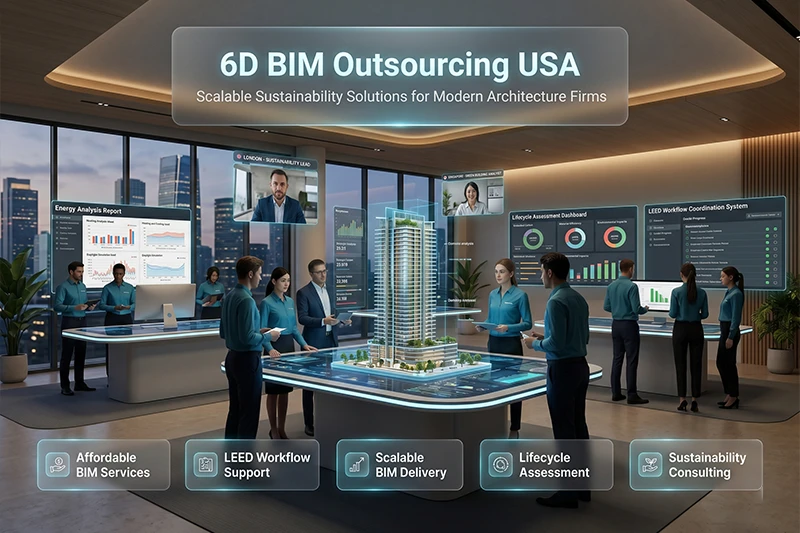
As sustainability requirements grow increasingly complicated, many companies are outsourcing their 6D BIM modelling needs to third-party vendors in order to obtain expertise that is unique to their needs, as well as scalable solution options.
Cost is a key driver of this trend because of the high cost of maintaining an in-house sustainability BIM team. Firms putting together a 6D BIM process internally will likely incur higher internal operating costs than if they were sourcing 6D BIM services from external Vendors.
Another reason for the rise of 6D BIM modeling outsourcing in USA is access to more experienced professionals who work with BIM and are knowledgeable in various areas of sustainability, such as energy studies, lifecycle assessments, and LEED workflows.
Outsourcing also helps speed up the delivery of projects by allowing firms to quickly scale their BIM capacity to match their project needs. Scaling allows architecture firms to manage multiple projects while ensuring that each one retains the necessary levels of sustainability.
The best option for many firms may be to hire third-party 6D BIM consulting firms, especially consultants who are knowledgeable about both sophisticated BIM processes and the continuously changing regulations around green building codes.
How Designheed US Supports Sustainable Construction Projects
Designheed US is a provider of advanced BIM sustainability solutions specifically designed for American architects, engineers, contractors, and developers.
The following services are provided by the firm:
- 6D BIM services
- LEED-focused BIM workflows
- Energy modelling and sustainability analysis
- Lifecycle Assessment solutions
- Coordination/Clash Detection of the Building Information Model
- Custom solutions for green building projects.
By combining sustainability intelligence directly into BIM environments, Designheed US enables firms to improve building performance, achieve compliance efficiency, and reduce their environmental impact.
Whether you need support for a single commercial project or would like to outsource a long-term partnership, Designheed US provides scalable, cost-effective BIM solutions that meet today’s sustainability objectives.
Now is the time to engage the services of 6D BIM consultant USA professionals to streamline your sustainability-focused construction projects and deliver reliable BIM support to architects.
Conclusion
Building with sustainability in mind is now a requirement within the current US construction market; architects and developers have a responsibility to create buildings that are environmentally responsible, energy efficient, and focus on the well-being of the occupants while still complying with the new LEED and WELL certifications.
6D BIM provides the necessary resource data for creating the green buildings of tomorrow; this will allow architects to have access to both real-time energy consumption data, along with historical data showing how the energy consumed can be improved through data analysis, energy efficiency modelling, life cycle assessment, and operational optimization throughout all phases of construction.
Using the resources provided by Designheed US, architecture firms throughout the United States will have the ability to create effective BIM processes for sustainable building certification, enhanced certification processes, and ultimately a high-performing sustainable building.
Read More - 5D BIM Cost Estimation for US Contractors
Questions People Frequently Ask
Q1: What does 6D BIM mean in relation to sustainable building?
Ans: 6D BIM is a new generation of building information modeling that adds sustainability and lifecycle management, along with operational data to digital building models.
Q2: How does BIM help with LEED certification in the USA?
Ans: BIM can be used to create an energy simulation, analyze materials, plan for water efficiency, and provide documentation of compliance with sustainability throughout the project lifecycle.
Q3: What are the advantages of using 6D BIM for architects?
Ans: 6D BIM allows architects to make better design decisions, assist in meeting LEED requirements, reduce operational costs, and optimize long-term performance of buildings.
Q4: Can using 6D BIM reduce the operational costs of buildings?
Ans: Yes, incorporating 6D BIM techniques will allow an organization to improve its energy efficiency, plan for predictive maintenance, and perform better facility management, resulting in reduced operational spending as a building matures.
Q5: Why should I consider outsourcing 6D BIM services in the USA?
Ans: Outsourcing provides access to 6D BIM experts, quicker project delivery timelines, resources that can grow to meet project status, and cost-effective solutions for USA architects.
Q6: How does 6D BIM aid in the delivery of green building projects?
Ans: Using 6D BIM, the designer can analyze sustainability initiatives, model energy use, create plans for carbon reduction, and improve design through lifespan optimization.