
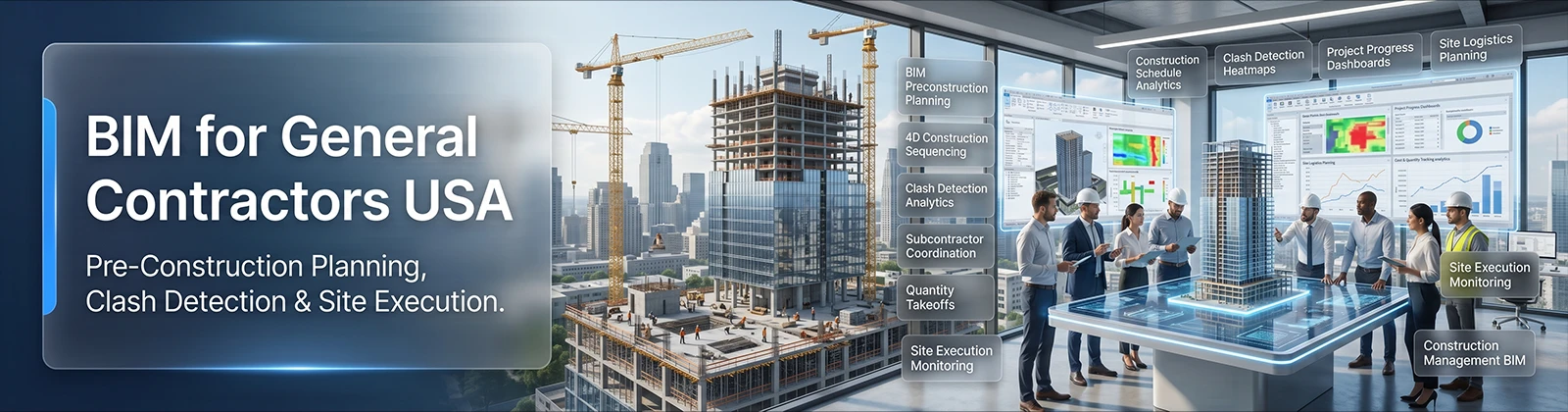
The Building Information Modelling (BIM) is revolutionising how BIM for general contractors in the USA deliver projects via precise pre-construction planning, clash detection, and improved site execution ordering. Designheed USA assists construction companies in utilising advanced GC BIM workflow, resulting in increased coordination, reduced rework, and improved outcomes for all projects. As such, BIM can lead to an increase in efficiency, collaboration, and oversight during all phases of construction through the continued use of BIM throughout all construction phases, including preconstruction, subcontractor coordination, and construction management.
Importance of BIM for General Contractors in the USA
In the past, contractors depended on 2D drawings, spreadsheets, and separate channels for communicating about their projects. That led to design clashes, exceeding the budget, and delays in completing projects.
With today’s general contractor BIM services, there is a better way of working together through the development of a digital, collaborative workspace in which all parties interact from one common source of information. BIM allows contractors to see the whole project before construction begins, ensuring better decision-making and less uncertainty.
For general contractors, the benefits BIM provides include:
- Improved project coordination
- Reduced costs due to construction rework
- Improved control of the cost of a project
- More efficient management of schedules
- More productive work at the construction site
- Easier communication among subs
- Greater assurance that quality has been met
As such, these advantages illustrate that BIM is a key tool for all modern-day BIM GC construction Projects in the United States.
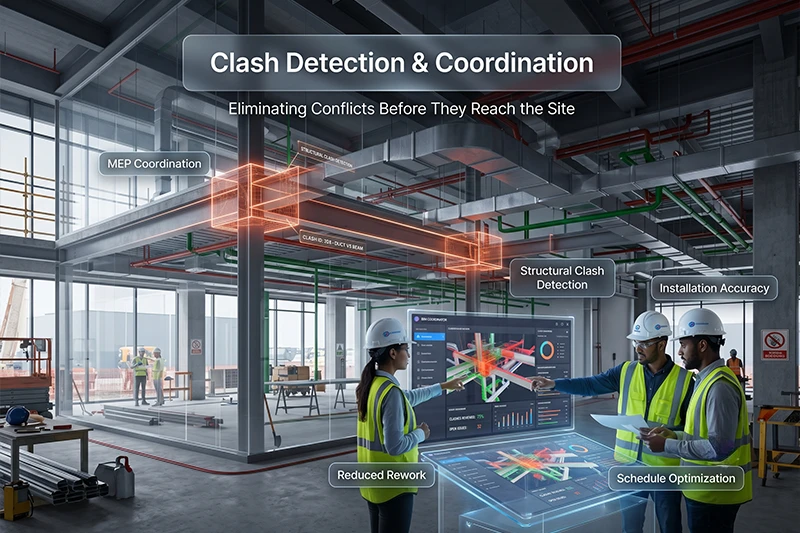
BIM Preconstruction USA: Building Success Before Construction Begins
One of the most significant applications of BIM preconstruction in the USA is early-stage planning. Prior to the arrival of equipment on-site, BIM provides an opportunity for the project team to model their construction activities and assess possible issues that can arise.
1. Design Validation
BIM permits contractors to examine the architectural, structural, and MEP (mechanical, electrical, and plumbing) designs, as they relate to each other, all within a single cohesive model. This provides an opportunity to approve the coordinated designs, identify discrepancies, missing data, and confirm constructability, well in advance of construction.
2. Accurate Quantity Take-Offs
Using digital models enables precise quantities to be obtained, which contractors can then use in cost estimates and in planning for any future procurement. The use of BIM-based quantity take-offs leads to more accurate budgeting and decreased waste.
3. Construction Sequencing
Contractors can visually observe the construction schedule and sequence of construction on a project by using a 4D BIM simulation. These simulations help contractors to identify scheduling conflicts and to optimize the allocation of their resources.
4. Site Logistics Planning
BIM can be used by contractors for planning the placement of construction equipment, material storage areas, access routes, crane lifting operations, and safety zones prior to mobilizing to the construction site. Thus, during the construction period, this will enhance the efficiency and safety of the construction site.
At Designheed US, we offer BIM preconstruction planning services to help contractors reduce uncertainty and establish a strong basis for the successful delivery of a construction project.
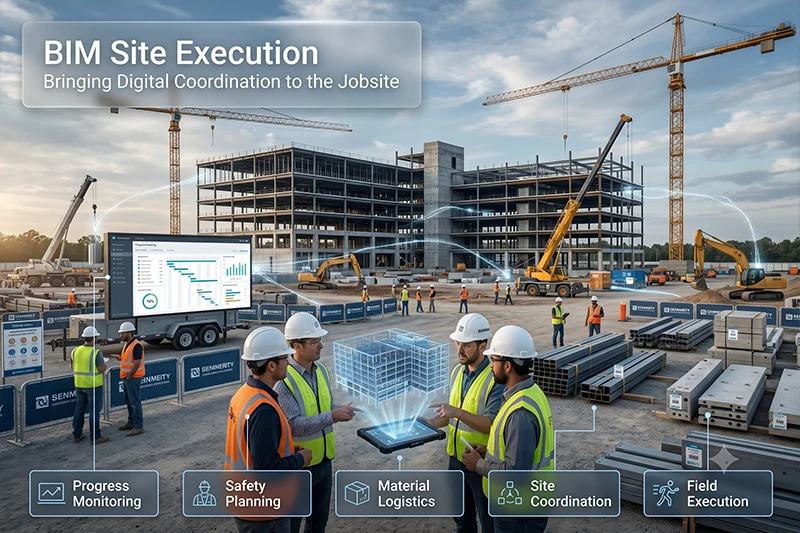
BIM Coordination GC USA: Eliminating Conflicts Before They Reach the Site
The coordination function of a general contractor is critical because there is generally more than one contractor; therefore, there generally are clashes of the various systems used to construct a building, and these occur because multiple disciplines are involved in constructing the building.
Clash Detection Defined - The concept of detection of conflicts in Building Information Modeling (BIM) refers to a process that detects physical conflicts between several different classifications of systems. The physical conflict actually exists at the physical location of an object, such as:
1. Structural beams meeting ductwork;
2. Pipes crossing electrical conduits;
3. Equipment softening the presence of systems in the ceiling.
4. Architectural elements interfering with MEP installations
With help from specialized BIM software, contractors can identify and address these clashes before the actual construction commences.
Benefits of BIM Coordination
Contractors engaged in BIM Coordination GC USA services realize tremendous benefits, including:
1. Fewer field conflicts;
2. Reduction in expensive rework;
3. Higher accuracy in installation;
4. Speeding up project schedules;
5. Improving the productivity of subcontractors.
Through BIM Coordination, project teams resolve clashes digitally, saving the contractor from costly corrections that are made on the project site and lead to delays and/or added cost.
BIM for Construction Management and Coordination
Construction managers can use modern BIM for construction management to manage and coordinate construction, allowing them to design in 3D and coordinate with all parties involved in the construction process from one common location for all project information at any time during the project.
Improved Collaboration -Access to coordinated models and project data by all collaborators (contractors, subcontractors, architects, and consultants) at the same moment can lead to improvements in collaboration due to less time spent on communication gaps and improved decisions.
Enhanced Subcontractor Coordination - Successful projects require proper coordination among multiple trades. By utilizing BIM, subcontractors can better understand the project's requirements, installation sequence, and any limitations on coordination with other trades.
Through the use of structured BIM subcontractor coordination in the USA, teams across various departments can:
- Review coordinated models
- Address design conflicts early in the process
- Efficiently track any issues
- Make installations accurately
- Minimize the time that projects are delayed
Industry professionals often reiterate that the value of having coordinated BIM is that it allows for improved accountability as well as the resolution of conflicts between parties involved in the project.
Enhanced Project Control - Contracting firms like Designheed US are able to leverage the benefits of having a BIM model to better visualize the progress of projects and provide construction teams with more accurate means for monitoring the project schedule, costs, and milestones related to the construction process.
Why General Contractors Choose Designheed US for BIM Services
As BIM becomes more widely accepted in the USA, selecting a suitable BIM partner is necessary for a successful project.
Designheed USA delivers effective BIM solutions and services to general contractors. Our professionals provide a full range of BIM services for general contractors throughout all phases of the construction process, and assist contractors with coordination, risk reduction, and overall operational efficiency.
Designheed USA provides a full range of BIM Services, including:
- BIM modeling & documentation
- BIM Pre-construction Planning
- Clash Detection & Coordination
- Construction Sequencing (4D BIM)
- Estimation Support & Quantity Take-Off
- BIM site execution USA
- Subcontractors Coordination
- Construction Management BIM Solutions
By utilizing industry-leading technologies and offering an experienced staff, Designheed USA assists general contractors in delivering projects more smoothly and achieving improved outcomes for their projects.
Conclusion
BIM general contractors in the USA are now required to utilize BIM technology due to its high acceptance across the construction industry. It allows contractors to improve their planning efforts prior to the start of construction, eliminate potential clashes prior to starting construction, improve coordination with subcontractors, and also enhance the BIM site execution in the USA.
Working with a firm that specializes in BIM, such as Designheed US, allows general contractors to maximize their use of BIM technology towards higher levels of efficiency, collaboration, and success on their projects.
Frequently Ask Questions
Q: What is BIM for general contractors USA?
A: The Building Information Modeling (BIM) Technology is being used throughout the construction process by General Contractors in the United States to enhance planning, design, scheduling, management of construction, and execution of projects overall.
Q: How does BIM help during pre-construction planning?
A: BIM supports pre-construction planning with the following tools: Design Review, Quantity Takeoff, Cost Estimate, Constructability Analysis, and 4D Coordination; all of which will enable the contractor to identify any potential issues before construction starts.
Q: What is clash detection in BIM?
A: Clash detection is the identification of conflicts between the architectural, structural, and mechanical, electrical, and plumbing (MEP) components of a written BIM Model to identify and resolve any potential conflicts before being constructed at the physical construction site.
Q: Why is BIM coordination important for general contractors?
A: The process of coordination between the various construction teams and disciplines involved with a large-scale construction project can be very time-consuming. BIM coordination provides a better way for construction teams to work together, to minimize conflicts that will arise in the physical construction of the buildings, ensuring that, through the GC BIM workflow, the project stays on schedule and can be completed within budget.