

Building Information Modeling (BIM) adoption throughout the U.S is increasing exponentially as federal and state governments develop state building information modeling (BIM) Mandates for public projects. By the end of 2026, staying updated with each state's unique BIM Standard will become increasingly crucial to be awarded any relevant projects as well as remain compliant. Designheed US provides the necessary support for architects, engineers, contractors, and design companies.
Understanding the Growing Importance of BIM in Public Projects
Government agencies are starting to see BIM as a kind of strategic thing that actually helps with project planning, design coordination, construction management, and, later on, facility operations. With BIM, people and teams can work together in one shared digital space, so errors tend to drop, less need for project rework, and asset management feels more organized across the whole life of a building.
Building Information Modeling is growing significantly across government projects for a set of 6 key objectives rather than one:
- Increased project transparency and insight,
- Seamless communication among all involved partners,
- Accurate cost estimations,
- Effective financial management/budget constraint,
- Reduced construction conflicts that lead to schedule delay,
- and better maintenance in the project's lifespan as soon as the project is complete.
Furthermore, BIM brings added sustainability benefits as well as greater lifecycle project delivery.
As digital transformation keeps becoming a priority across public infrastructure programs, BIM is shifting from “nice to have” or a recommended practice into something closer to a mandatory requirement for many projects funded by government money.
BIM Mandates USA 2026: Federal Level Adoption
While there isn't one overarching BIM Mandate USA 2026 on the horizon, a number of government agencies are incrementally adding BIM mandate language for select projects over the years. In reality, it's more of multiple mandates popping up in different venues, with varying methods.
Some federal organizations that often ask for BIM implementation include:
- General Services Administration (GSA)
- U.S. Army Corps of Engineers (USACE)
- Department of Veterans Affairs (VA)
- Department of Defense (DoD)
- National Aeronautics and Space Administration (NASA)
While there is often talk of specific BIM deliverables (BIM for design coordination, facilities management, asset tracking, lifecycle maintenance, etc.), things do vary on a case-by-case basis with your project. The federal government has played a large role, with the Federal BIM push encouraging other states to establish their own statewide plans for implementing BIM. It’s inspiring how much progress is being made and how this progress is encouraging other cities/states to develop their local plans for incorporating BIM in their infrastructure initiatives.
At Designheed US, we keep a close eye on what is happening at both the federal and state levels so organizations can stay compliant with the changing digital construction expectations, with less last-minute stress.
BIM Requirements by State USA in 2026
Unlike other regions that have more central BIM guidance, the BIM US adoption is a little scattered, driven by the state rather than country-level mandates. While some states have come to form more of an official standard regarding BIM in state-funded work, many others just provide some guidance or a preference that’s specified within agency instructions or project solicitations. In short, there isn’t a true, uniform standard which, as you can probably guess, can be kind of messy.
Here is a snapshot of BIM adoption trends across several key states in 2026, with a bit of nuance:
- California - California is still one of the leading states for BIM, at least in terms of momentum. A number of state agencies and public institutions encourage BIM use for large-scale infrastructure, transportation, educational, and healthcare projects.
Public owners often require BIM for things like:
- Design coordination
- Clash detection
- Construction planning
- Facility management documentation
And as sustainability initiatives, plus smart infrastructure projects, keep expanding, BIM adoption continues to move forward across California’s public sector.
1. Texas - Texas has been warming up to BIM more and more, especially for transportation, education, and municipal building projects. A lot of public agencies ask for BIM deliverables so they can focus on:
- Project visualization
- Cost management
- Asset lifecycle planning
- Team coordination across the whole project
For firms trying to win public contracts in Texas, knowing the BIM process end-to-end is becoming a kind of competitive must-have.
2. New York - New York keeps pushing BIM for public infrastructure. Today, state and city governments are more and more asking for BIM deliverables for large-scale capital improvement projects, hospitals, universities, and transit projects. On the other hand, the reason you continue to hear buzz about BIM is that it can be used to improve coordination in the project execution and then help facilities over the long haul.
3. Florida - Florida has also broadened BIM adoption for government-funded projects involving transportation infrastructure, public buildings, and educational facilities.
3. Other States Expanding BIM Adoption - A bunch of states, including Colorado, Washington, Massachusetts, Illinois, and North Carolina, are also going further with BIM adoption across public infrastructure work. Even though the rules shift from one agency to another, and project size plays a role too, BIM is slowly becoming a normal expectation for a lot of government-funded builds.
At Designheed US, we usually tell firms to look through the procurement documents tied to each specific project carefully. Cause BIM expectations can vary a fair amount between agencies, even if they’re in the same state, so it’s worth checking early.
Public BIM Mandate US 2026: Why States Are moving toward BIM requirements
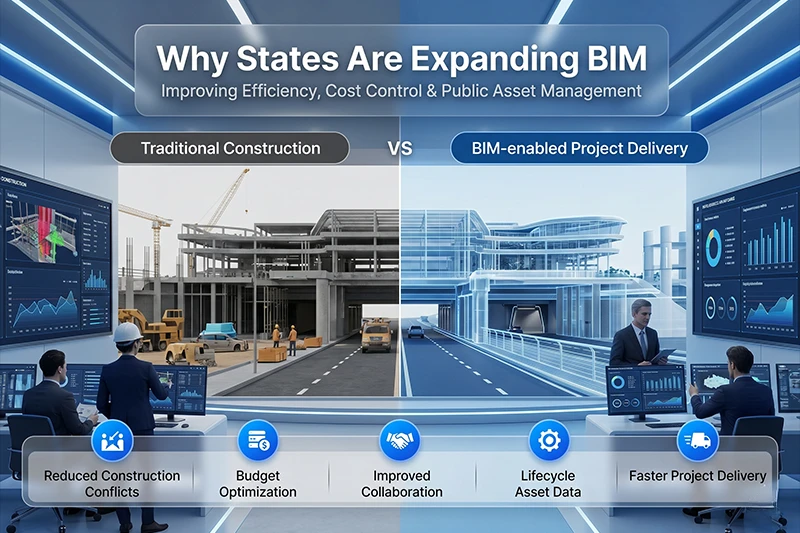
The shift to a wider public BIM mandate in the US is mostly being pushed by project benefits you can actually measure.
- Improve Project Efficiency: The BIM identifies design conflicts before projects are built, cutting project delays and costly rework significantly.
- Budget Management: Project teams are able to provide more accurate cost estimates, better quality estimating, and maintain predictable cost control for the entire project lifecycle instead of just one aspect.
- Improved Collaboration: BIM works as a sort of central repository that integrates all stakeholders, from architects and engineers to contractors and even facility operations personnel. The BIM model serves as a single source of truth about the building/infrastructure.
- Asset Management: Several governmental bodies utilize BIM information as the basis of operations & maintenance of a building/infrastructure. This data can also be used to assist with future renovations & expansions. Thus, these various benefits justify the reasons for the states. Increase the mandatory usage of BIM for public project & construction throughout the county, as BIM utilization on public projects expands.
So, all in all, these advantages keep reinforcing why states are expanding BIM requirements across public-sector projects, nationwide, even as adoption continues to grow.
US BIM Regulations 2026: Key Compliance Expectations
Since the use of BIM is rapidly growing, companies going after public work really need to understand what the emerging US BIM Regulations 2026 actually expect from them. Like, not just “having models”, but proving they can comply, on time and in the right way.
People often run into common requirements such as:
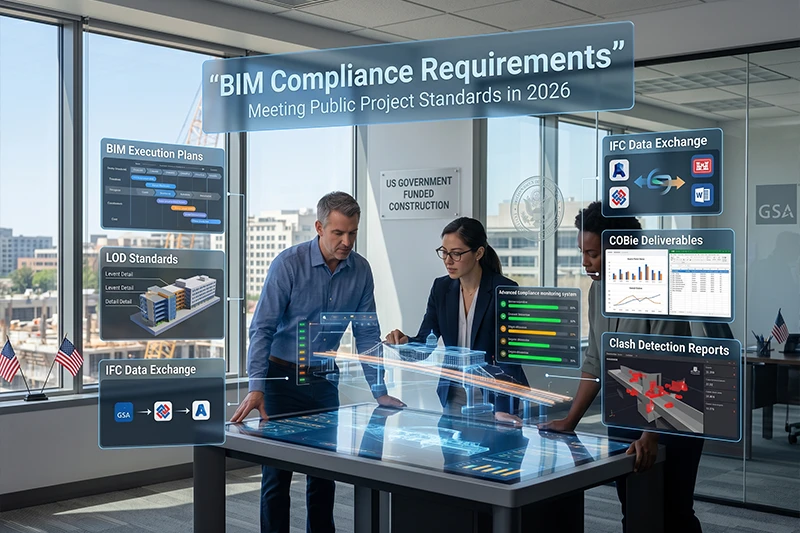
BIM Execution Plans (BEP) - Project teams are often asked to submit a BIM Execution Plan that lays out things like:
- Project objectives, a clear direction basically
- Modeling standards and how they’re applied day to day
- Who does what, team responsibilities, not vague roles
- Data exchange protocols and how files move around
- Coordination procedures, including review rhythm and handoffs
- Level of Development (LOD) Standards
Many agencies specify what Levels of Development are expected for BIM deliverables at different stages. Sometimes it’s stage-by-stage, sometimes it’s deliverable-by-deliverable, so teams end up mapping it carefully, just to stay safe.
Clash Detection Requirements - Contractors and consultants might need to perform formal clash detection, then share coordination reports. Usually, these aren’t “optional”, and they’re expected to show what was checked and what got resolved.
Data Exchange Standards - Public agencies are increasingly pushing teams to follow recognized industry standards, such as:
- IFC (Industry Foundation Classes)
- COBie (Construction Operations Building Information Exchange)
- Agency-specific BIM standards
- Facility Management deliverables and related outputs
Also, government owners frequently request as-built BIM models that actually support facility maintenance and asset management, after project completion. In other words, it’s not only for design coordination anymore.
At Designheed US, we help project teams grasp and implement these BIM Compliance Requirements effectively across the full project lifecycle, from early setup until the final handover, and beyond.
Conclusion
The BIM landscape across the United States is moving along pretty steadily, since public agencies keep expanding their digital construction requirements. Even if there isn't a nationwide BIM mandate yet, state and federal BIM adoption is still growing. Firms that get ahead of the curve by matching the evolving rules, tightening up compliance processes, and putting money into BIM capabilities will generally end up in a better spot to win public-sector projects. And at the same time keep their long-term competitiveness, you know, from slipping later.
Read More - BIM Structural Services in the USA
Frequently Asked Questions
Q1: Is there a nationwide BIM Mandate for the USA in 2026?
Ans: No, right now, there isn't any federal law that makes BIM mandatory for all public projects, nationwide. Still, a lot of federal agencies and several state governments have kinda put their own BIM rules in place, for certain project types, and that varies from one place to another.
Q2: Which states have the strongest BIM requirements?
Ans: In general, states such as California, Texas, New York, Florida, and Virginia are often seen as leading adopters when it comes to public-sector construction. But again, the exact rules can vary by agency or by project category.
Q3: What are the BIM Compliance Requirements for government projects?
Ans: Common requirements usually include a BIM Execution Plan, clash detection activities, Level of Development expectations, data exchange protocols, and deliverables for facility management. Sometimes the wording is different, but the core idea stays similar: coordination, documentation, and then handover.
Q4: Why is BIM important for public construction projects?
Ans: BIM for public construction projects helps people collaborate better, it can reduce project risks, it supports tighter budget control, and it also makes long-term facility management more practical. It gets the design and the operations story into one place instead of splitting it into random silos.
Q5: How can firms prepare for BIM regulations in 2026?
Ans: Organizations should put some effort into BIM training, sort of align their day-to-day workflows, switch to a newer BIM software, and make sure they keep in the loop about the agency-specific requirements and rules.