
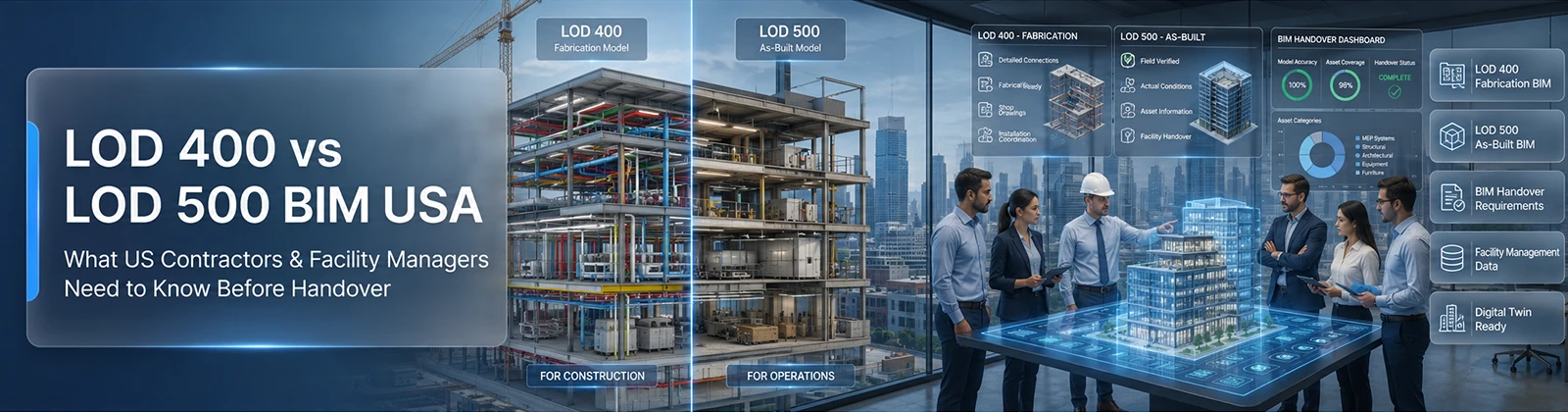
For project managers and facility operators to effectively manage their projects and operate their facilities, understanding the differences between LOD 400 and LOD 500 BIM USA standards will be essential. While LOD 400 is used to back fabrication and construction action, LOD 500 gives verified as-built documentation for long-term facilities management. By selecting the appropriate BIM deliverables before handing over a project, contractors, facility managers, and owners can ensure that the project will operate efficiently, comply with all applicable codes, and be successful.
What US Construction Firms and Facility Managers Need to Know About LOD 400 vs LOD 500
As more and more firms in the United States begin adopting Building Information Modelling (BIM), the emphasis is now on model accuracy, construction coordination, and ultimately, the management of assets over their life cycle by project stakeholders. Unfortunately, a great deal of confusion exists among owners, contractors, and facility teams as to the differences between LOD 400 and LOD 500 BIM USA requirements.
Understanding the various levels of development of BIM is important, as these levels directly impact the project's fabrication and installation processes, project closeout, and the successful management of the facility. As a contractor executing a commercial project or a facility manager preparing to operate the completed building, understanding the differences between the two levels of BIM will help you eliminate potential problems from occurring during project handover.
Designheed US frequently assists contractors, architects, engineers, and building owners to establish BIM deliverables that are in line with the objectives of the project as well as the operational needs of the facility in the long-term.
Understanding BIM Levels of Development
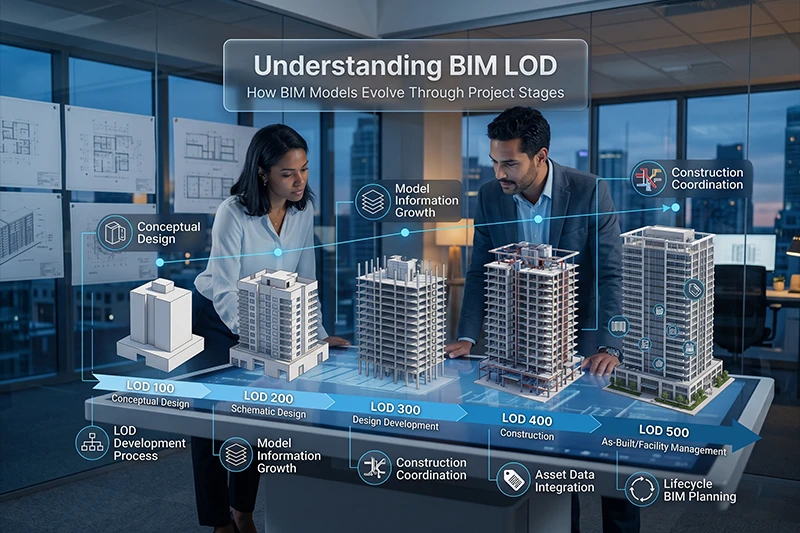
BIM Levels of Development, or LOD, provides a common approach to relating the accuracy and completeness of BIM objects over the course of a project's life cycle.
The LOD Guide for BIM in the USA allows all stakeholder parties to understand the evolution of the information associated with a model from the conceptual stage through to construction and operation activities.
There are quite a few LOD levels, though LOD 400 and LOD 500 are definitely the most important because they mark this shift from the built implementation phase into the operational phase for the facility.
LOD 400 is defined as a BIM Model containing fabrication-level detail, adequate for use in the fabrication, assembly, installation, and construction activities.
At the LOD 400 stage, BIM elements include:
- Dimensions for fabrication
- Assembly details
- Detailed connections for installation
- Additional installation requirements
- Manufacturer-specific components
- Information needed to complete shop drawings
For most general contractors performing work with BIM LOD, the LOD 400 is the BIM Model they will use primarily throughout construction. Most of the trade contractors will utilize these models in the process of fabricating ductwork, piping systems, structural elements, and prefabricated assemblies.
Usually, LOD 400 fabrication BIM Models are created by Designheed USA to facilitate the smooth coordination between architects, engineers, fabricators, and the respective field operations teams.
What is LOD 500?
LOD500 is a type of model that represents:
- Actual conditions
- Verified dimensions
- Confirmed equipment locations
- Maintenance asset information
- Operational information
- Facility management records.
A misconception is that LOD 500 is a more detailed version of LOD 400. The difference is that LOD 500 models concentrate on verification and accuracy, while LOD 400 utilises an increased level of detail.
Facility managers can use LOD 500 models for operational information to aid in the planning and scheduling of maintenance, tracking of assets, renovations, and the lifecycle of facilities.
LOD 400 vs 500 Comparison
Here is a clear LOD 400 vs 500 comparison that helps stakeholders determine the type of deliverables needed at different project stages:
|
Aspects |
LOD 400 |
LOD 500 |
|
Primary Purpose |
Creating detailed models to guide shop fabrication, manufacturing, and on-site assembly. |
Lifecycle management provides the owner with a digital manual to run and maintain the completed facility. |
|
Information Source |
Depends on design documents combined with precise manufacturing specs and vendor data sheets. |
Relies entirely on direct, physical field measurements and actual operational handovers. |
|
Accuracy Level |
Delivers exact, millimetre-precise geometry ready to go straight to a fabrication shop floor. |
Delivers legally and physically verified coordinates reflecting the building's true, final state. |
|
User Group |
Trade subcontractors, fabricators, MEP technicians, and structural engineers during assembly. |
Property managers, maintenance engineers, asset supervisors, and facility owners. |
|
Project Phase |
Active during the construction and procurement phase when elements are being built and installed. |
Begins at building handover and remains active throughout the post-construction operational lifecycle. |
|
Data Verification |
Verifies that components fit together perfectly on paper and meet the planned coordination clearance rules. |
Checks that the components line up with what was physically installed, behind the walls, in the ceilings, and on the ground. |
The comparison between LOD 400 and 500 shows the fact that they both have different functions but have equal value.
LOD 400 focuses on how to create it using exact specifications for fabrication information, and LOD 500 is focused on what was created, how well it met those requirements, verified by field measurements and turnover of ownership/operation to the owner.
At Designheed US, we recommend clearly defining the expectations of both LOD before getting into the BIM Execution Plan (BEP) so that there is no confusion at the end of the project.
Why Contractors Need LOD 400
LOD 400 is considered to be the best model for contractors during the active construction phase. Here are the key benefits:
- Better Coordination - LOD 400 fabrication BIM models allow for better coordination among the different disciplines and a reduction of field conflicts between building systems.
- Better Prefabrication - Trade contractors can prefabricate their components with confidence, which will allow for improved schedules and reduced waste.
- Reduced Rework - Providing accurate information for fabrication reduces the need for field modifications and costly installation mistakes.
- Better Construction Planning - Most contractors use BIM LOD 400 models to plan their sequencing, logistics, and constructability.
Designheed US assists with the development of fabrication-ready BIM models, enabling contractors to execute their projects efficiently.
Why Facility Managers Need LOD 500
Once a project has been completed, facility manager BIM USA requires accurate information about how to operate and maintain the asset efficiently.
An accurate LOD 500 as-built USA model provides:
- Accurate Asset Information - Facility managers will have access to equipment specifications, warranties, and maintenance schedules.
- Faster Maintenance Operations - A good BIM USA workflow for a facility manager allows maintenance staff to locate building systems and troubleshoot problems quickly and efficiently.
- Easier Renovation Planning - If as-built information is readily available, future modifications to the asset will be easier.
- Digital Twin Readiness - LOD 500 serves as the basis for creating a digital twin and implementing smart building strategies.
At Designheed US, we assist owners in developing BIM models that provide a digital representation of their facilities and maintenance strategies.
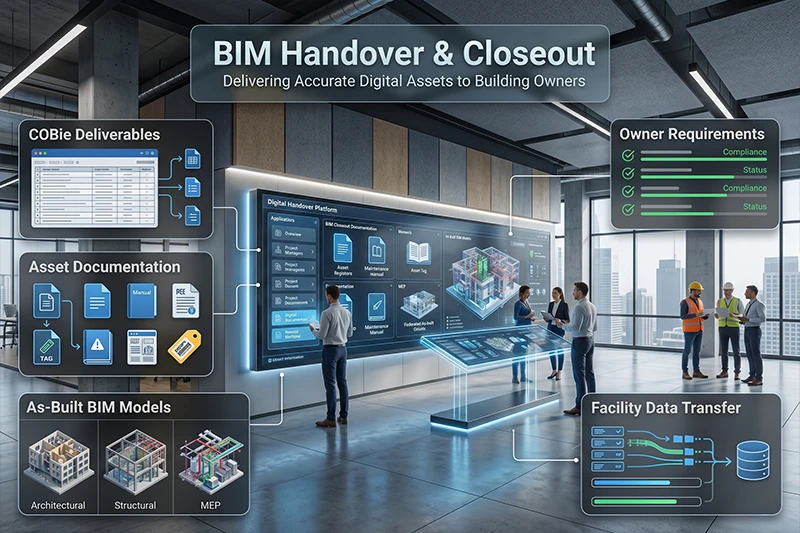
BIM Handover Requirements in the United States
The process of handing over a BIM product in the USA is only as successful as the owner’s requirements are clearly defined. Unfortunately, there remains a great deal of confusion among parties on construction projects because many assume that once a construction model has been completed, it will automatically be an "as-built" or "BIM" model.
In fact, the BIM handover USA requirements should specifically include:
- Required LOD level
- Asset information standards
- Facility management integration requirements
- Data validation procedures
- Documentation formats
When providing support for BIM handover projects, DesignheedUS will ensure that owners will have the required information for continued maintenance of the building.
Best Practices for Successful Handover of BIM
The following best practices should be followed to create a successful BIM handover process in the USA:
- Define LOD Requirements - Establish whether the owner will want an LOD 400 or 500, and how many will be required.
- Define Verification Procedures - Create a validation process to validate that all as-built conditions were met before project completion.
- Standardise Data Requirements - Ensure all information on the assets follows agreed standards.
- Engage the Facility Manager Early - By including the facility manager in the early stages of the BIM USA process, operational data can be captured as part of project planning.
- Partner with BIM Experts - BIM experts such as Designheed US can assist with streamlining the development of models, validating the models, and documenting close-out procedures.
Conclusion
The differing levels between LOD 400 and LOD 500 can have a dramatic effect on project delivery and long-term operations of the facility. LOD 400 delivery through fabrication BIM will aid in the construction and installation stages of the project; however, LOD 500 delivery through as-built models provides the verified information required for effective asset management.
It is critical for contractors, owners, and facility managers to comprehend the differences between these two deliverables to effectively define their USA owner deliverable requirements, manage their USA closeout deliverables, and create a successful USA handover strategy.
Working with experienced BIM consultants such as Designheed US, project teams will be able to provide the right level of development at the appropriate time, providing ongoing value throughout the life cycle of the building.
Frequently Asked Questions
Q: What is the difference between LOD 400 and LOD 500 in BIM?
A: The main difference between LOD 400 and LOD 500 (building information models) is that LOD 400 models are based on the supply chain, namely, the specification of all the materials needed to build a structure and the assembly of those materials. LOD 500 is concerned with the ongoing management of a facility by the end user, which will be accomplished through the use of LOD 500 as-built models.
Q: Is LOD 500 required for every project in the USA?
A: LOD 500 as-built models are not always a requirement for a project in the USA. In the USA, the requirement for using LOD 500 as-built models on a project will depend on the Owner's needs, the need for Facility Management, and the contract for the project.
Q: Why is LOD 400 important for contractors?
A: Contractors benefit from the fabrication information (BIM) in LOD 400 by providing them with the construction-ready information they need for coordination, prefabrication, clash detection, and installation planning.
Q: What should be included in BIM closeout deliverables?
A: Some examples of BIM closeout deliverables in the USA are as-built models, equipment data, maintenance records, COBie information, warranties, and operating documentation.
Q: How does LOD 500 benefit facility managers?
A: BIM workflows that utilize LOD 500 models can provide fundamental benefits to Facility Managers as LOD 500 models support many aspects of Facility Management, including Asset Management, Maintenance Planning, Renovation Planning, and Building Operations.
Q: What is a BIM owner deliverable?
A: The term BIM Owner deliverables in the USA refers to the digital information and documentation that Owners will require upon the completion of a project to properly manage and operate their facilities.